The transport sector is moving toward digital freight documentation - and for operators in key markets, the regulatory clock has officially started.
Frameworks like eCMR and eFTI are accelerating the move away from paper-based transport operations. Backed by ambitious national developments, most notably in Spain, companies must prepare for a digital-first legal landscape.
Shippeo’s Legal team is closely tracking these developments. This article is the first in a series designed to help transport operators stay ahead of upcoming regulatory changes.
The Shift Away From Paper
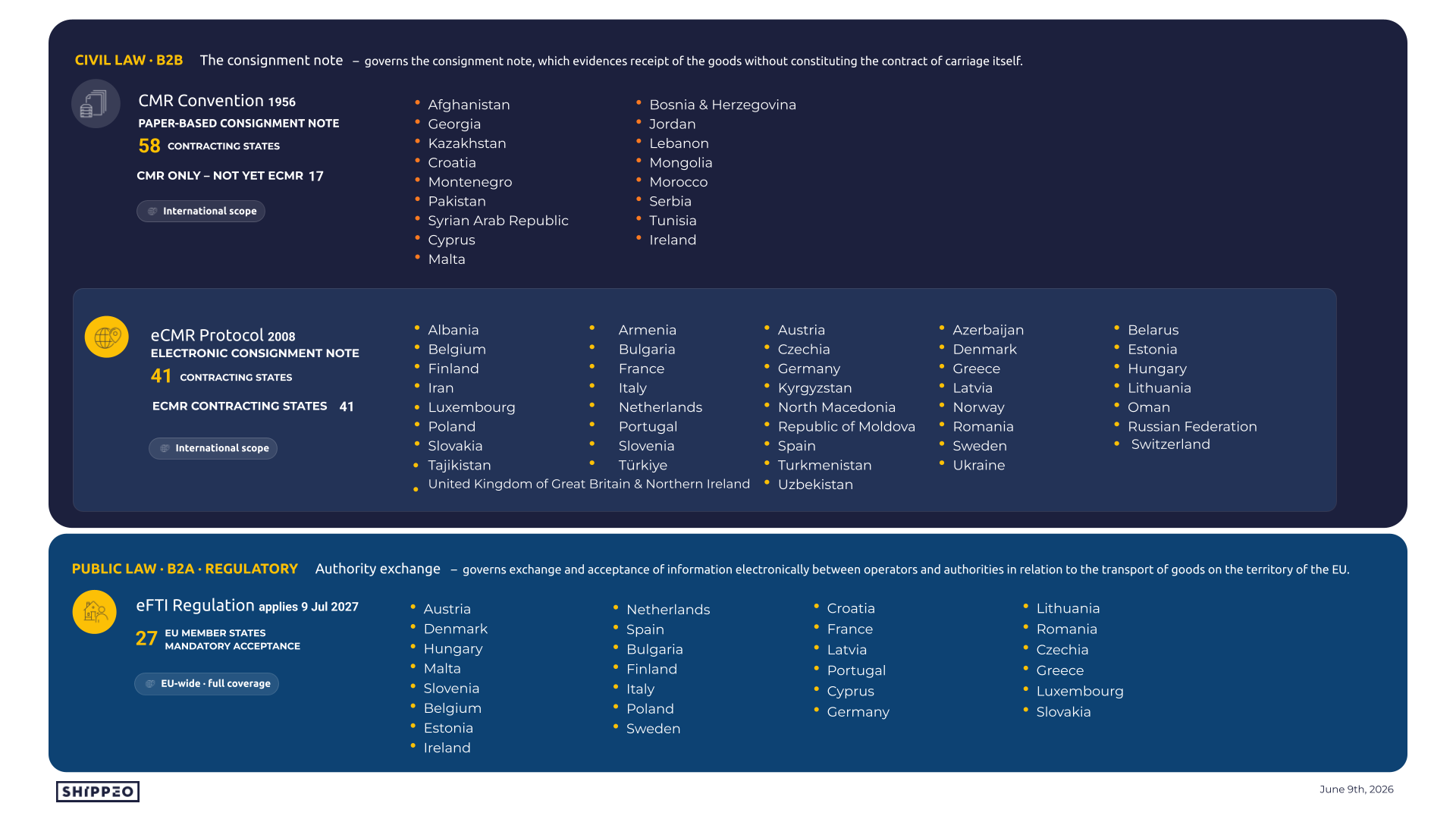
Traditionally, transport consignment notes existed only in paper form under the CMR Convention, the international framework governing cross-border road freight transport (Convention of the Contract for the International Carriage of Goods by Road 1956).The Convention applies when goods are transported by road between two countries, provided at least one of them is a contracting state of the CMR Convention.
The consignment note serves as proof of the making of the contract of carriage and the receipt of the goods but does not constitute the contract of carriage itself. Instead, it serves as prima facie evidence in the contractual relationship between involved parties (civil/private law document).
What eCMR Changes
In 2008, the Additional Protocol to the Convention (Additional Protocol) introduced the electronic consignment note - the eCMR. The principle is simple: an eCMR that meets the Protocol’s requirements is considered legally equivalent to the CMR paper version.
One important limitation remains: not every contracting state of the CMR Convention has adopted the eCMR Additional Protocol yet. Today, only 41 of the 58 CMR contracting states have ratified the Additional Protocol. As a result, countries that have not ratified the Protocol do not grant the same legal recognition to the eCMR as they do to paper consignment notes.
Why eFTI Matters
In 2017, the European Union identified a gap in the legal framework governing digital freight documentation. This gap was limiting the practical implementation of existing international frameworks, including the CMR Convention and the eCMR Additional Protocol.
Two key challenges were identified: (1) acceptance of e-documentation by all Member States and their authorities and (2) lack of generally applicable and binding rules on electronic transport documents.
To address these issues, the European Commission included the “recognition of electronic transport documents for freight carriage by public authorities and/or commercial partners” as one of the key initiatives in its work program for the year 2018.
After years of preparatory work, the EU adopted Regulation (EU) 2020/1056 on Electronic Freight Transport Information, known as eFTI. It establishes a harmonized legal and technical framework for the electronic exchange of freight transport information between businesses and public authorities, ensuring that information shared through compliant eFTI systems can be recognized electronically across the EU. From July 2027, authorities across the EU will no longer be allowed to reject compliant digital freight documents.
Important: eCMR concerns the electronic consignment note used as evidence of the contract of carriage (B2B). eFTI concerns the electronic provision of regulatory transport information to competent authorities (B2A).
Looking further ahead: Article 16 of eFTI requires the European Commission to carry out an assessment by February 2029, explicitly considering whether to introduce a mandatory obligation for operators to make transport information available electronically. The direction of travel is clear.
Spain’s 2026 Deadline
The digital trend is further reinforced by national-level developments, with Spain leading the way: Spain adopted the Sustainable Mobility Act, which explicitly states that the Spanish control document (Documento de control administrativo, DCA) must be issued digitally from October 2026 onwards. Both shippers and carriers may be held liable if the required control document is not properly issued.
While the eCMR and the Spanish DCA are different legal documents, their use may overlap in practice: according to Spanish law, a(n) (electronic) consignment note issued in accordance with national, international or EU legislation may, under specific conditions, simultaneously serve as the DCA.
A new Spanish regulation is currently being drafted that will revise the technical requirements for a valid electronic DCA and is expected to be adopted and published before the obligation takes effect in October 2026.
Shippeo is compliant with the current Spanish regulatory requirements for electronic transport control documents (DCA), having completed the mandatory domain URL registration with the Spanish Ministry of Transport and Sustainable Mobility ahead of the October 2026 deadline.
What Transport Operators Should Expect
The legal and regulatory landscape is evolving towards greater use of digital freight documentation.
For transport operators, carriers, and logistics teams, preparing early will be key to staying compliant and avoiding operational disruption as new rules come into force across Europe.
Shippeo's Legal team continues to monitor regulatory developments across EU and key national markets to help customers stay ahead of upcoming changes.
Shippeo is committed to developing solutions that align with emerging legal and regulatory requirements, helping customers navigate the digitalization of transport documentation with confidence.
Contact Shippeo’s Legal Department to learn more about the digitalization process of transport documentation: legal@shippeo.com.
Latest blogs & product releases.
Authors