eCMR is becoming more than a regulatory requirement. By connecting digital transport documentation with shipment data and operational workflows, organisations can reduce manual administration, accelerate invoicing, improve dispute resolution and create a more scalable transport execution process. With regulatory developments such as Spain’s October 2026 requirements and the EU’s eFTI framework, now is the time to prepare for compliance while unlocking broader operational value.
For years, the business case for electronic consignment notes (eCMRs) has been easy to understand. Paper-based transport documentation creates administrative work, delays access to information, and makes it harder to establish what happened when something goes wrong.
Yet for many organisations, there have always been more pressing digitalisation priorities.
Regulation is changing that. New requirements are pushing digital transport documentation higher up the agenda across Europe. But treating eCMR purely as a compliance exercise would miss a much bigger opportunity: to improve how transport operations are executed every day.
Why eCMR is moving up the agenda
The move away from paper is not new. Shippers and carriers have discussed the benefits of moving away from paper for years: less administration, easier archiving and faster access to proof of delivery.
What is changing is the external pressure to act.
The EU's eFTI framework is establishing the conditions for electronic freight information to be accepted by authorities across Europe, and there are national initiatives that create immediate deadlines. Spain, for example, is introducing mandatory digital transport documentation for relevant domestic road transport operations from October 2026.
As a result, eCMR is moving up the agenda. Transport and supply chain teams increasingly need to understand not only what the regulations require, but what digital documentation will mean for their day-to-day operations and how to make that transition work in practice.
And that requires looking beyond the document itself.
More than replacing paper
Consider a relatively ordinary delivery.
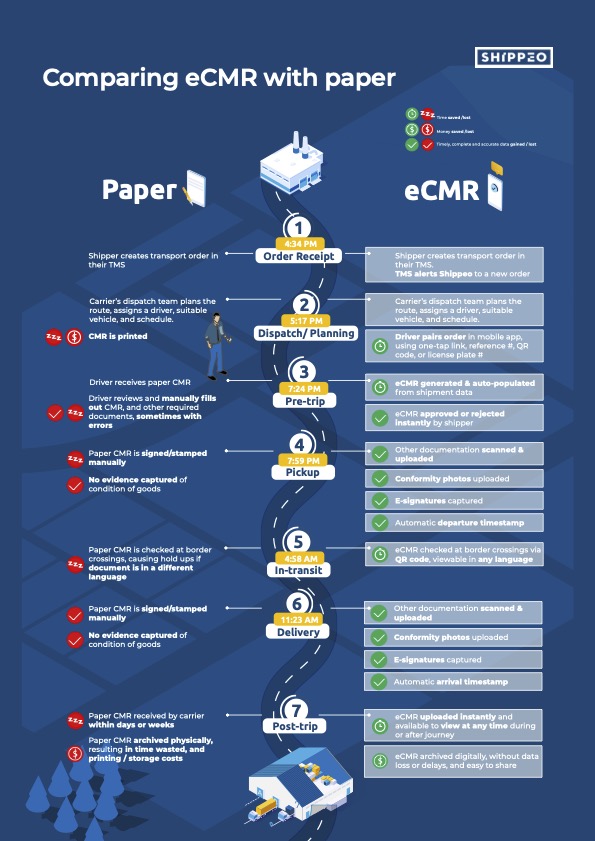
Goods arrive at a warehouse, quantities are checked, the delivery is signed and the driver continues to the next stop. With a paper-based process, the signed document may not reach the transport office until hours or days later.
Finance may be waiting for proof of delivery before invoicing. If a pallet is damaged or a quantity is disputed, customer service may need to reconstruct what happened from emails, calls and different copies of the paperwork.
There are other practical complications. The driver may be present at loading, but a warehouse employee is responsible for confirming what was actually loaded. At delivery, the person authorized to confirm receipt may not be available when the truck arrives. A process designed around a piece of paper physically following the driver does not always reflect how transport operations actually work.
Digital documentation provides an opportunity to address these frictions. Signatures, quantities, comments, photos and exceptions can be captured as part of the shipment workflow and made available to the relevant teams as events happen.
In practice, this can mean:
- Less manual administration: less printing, scanning, chasing and archiving of documents.
- Faster financial processes: proof of delivery can become available earlier instead of holding up invoicing.
- Clearer evidence when something goes wrong: signatures, timestamps, quantities, comments and photos can provide a trusted record for claims and disputes.
- Better coordination: documentation can be connected with transport events rather than managed as a separate process after the shipment has taken place.
Why Shippeo built eCMR as part of transport execution
This operational reality has shaped how we built Shippeo eCMR.
Real-time transportation visibility answers critical questions during a shipment, such as: Where is it? When will it arrive? Has a milestone been completed?
Digital transport documentation adds another layer: What was actually loaded or delivered? Who has confirmed it? Was there an exception? And where is the trusted record of what happened?
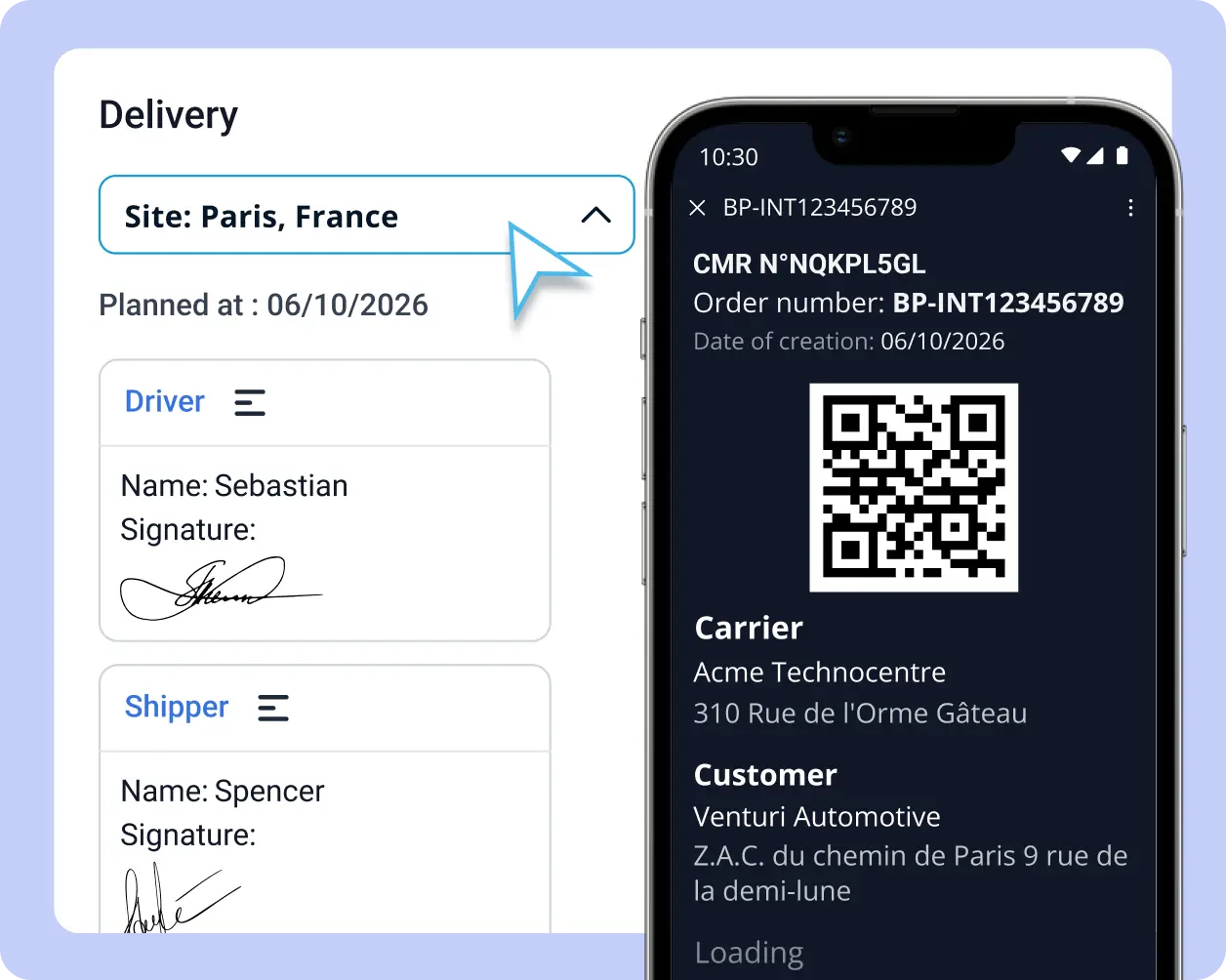
That’s why Shippeo eCMR is designed as part of transport execution, not as a standalone document tool. By connecting digital transport documentation with shipment data and operational workflows, teams can capture signatures, quantities, comments, photos and delivery exceptions alongside the transport itself, and make that information available to the people and systems that need it.
This matters in complex transport networks. Shippers may work with dozens or hundreds of carriers, as well as subcontractors, warehouses and receivers. It is unrealistic to assume that every participant will interact with documentation through the same system or workflow. A scalable eCMR approach therefore needs to accommodate different ways of participating – whether through mobile and web-based workflows, APIs or enterprise system integrations – while keeping documentation connected to the shipment.
For organizations already using Shippeo, documentation can be embedded into existing transport workflows and connected with the carrier ecosystem and transport data they already work with. This reduces the need to introduce another standalone tool, minimizes change for carriers and operational teams, and makes eCMR easier to adopt and scale across the network.
What to look for beyond compliance
Regulatory conformity is naturally one of the first considerations when organizations evaluate eCMR solutions.
Can the required information be captured? Are documents accessible for inspection? Can they be securely retained? Can the solution adapt as legislation and standards develop?
Those questions are essential. But an eCMR project should also prompt a second set of questions:
- Does the solution fit the way our transport network actually operates?
- How will drivers, warehouses, carriers, subcontractors and receivers participate?
- Can documentation connect with the transport data and enterprise systems we already use?
- Can we access trusted evidence quickly when dealing with an inspection, invoice, claim or customer query?
- Will the approach still work if different carriers or partners use different systems?
These questions become more important as organizations move from a limited implementation to broader adoption.
A compliant document is essential. A process that people can actually use across a complex transport network is what makes it scalable.
What should organizations be doing now?
The regulatory landscape is still evolving, and requirements will not develop at the same pace in every European market. That is not necessarily a reason to wait. Organizations can already do much of the groundwork required for digital transport documentation.
1. Understand where regulatory change affects your network first
Map the markets and transport flows where requirements are becoming most tangible. Spain is an obvious priority for many European transport networks, while eFTI and national developments should be monitored across the countries in which you operate.
2. Map the process, not just the document
Look at who creates, checks, signs, changes and retrieves transport documentation at each stage. Loading, delivery, invoicing and claims may involve very different people and systems. This often reveals process issues that simply converting a paper CMR into a PDF would not solve.
3. Understand how your carriers and partners will participate
Carrier adoption has historically been one of the challenges of transport digitalization. Assess which workflows already exist across your network and where mobile, API or web-based approaches may be required. The easier it is for partners to participate, the easier it becomes to scale.
4. Build the operational case alongside the compliance case
Regulation may create the deadline, but consider what else you want to improve. How much time is currently spent chasing documents? Where does missing proof delay invoicing? How are delivery discrepancies handled? These are useful baselines for measuring whether eCMR is delivering value beyond compliance.
Use upcoming regulatory deadlines to rethink the process
The shift to electronic transport documentation is coming, with Spain’s requirements creating an important near-term deadline from October 2026 and further regulatory developments taking shape across Europe. But compliance does not have to be the limit of the ambition.
For organizations already revisiting how transport documents are created, exchanged and stored, this is an opportunity to address a process that has remained fragmented and manual for far too long.
That is the thinking behind Shippeo eCMR: connect trusted transport documentation with the shipment, the network, and the operational data around it, rather than creating another standalone system for managing documents
Replacing paper solves one problem, making documentation part of transport execution opens up a much bigger opportunity.
Latest blogs & product releases.
Authors

Frequently Asked Questions
Related articles
Legal Focus: Spain’s DeCA Resolution. What Shippers and Carriers Need to Prepare Before 5 October 2026